


An Aero Commander pilot lined up on final approach to the wrong runway at Moorabbin, bringing the aircraft into close conflict with a C172 doing circuits, according to an ATSB investigation report released last week.
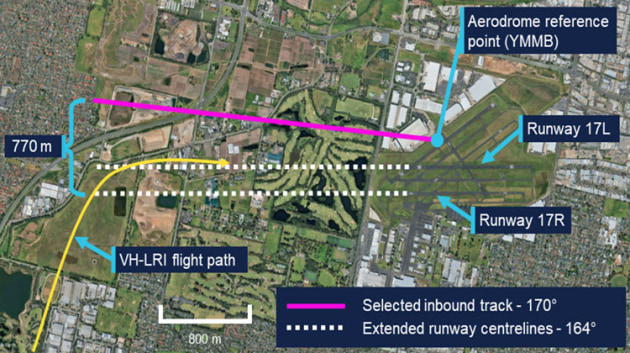
VH-LRI was being ferried to Moorabbin from Bacchus March in August this year when the pilot set-up their EFB and navigator to provide guidance to runway 17R because they were unfamiliar with Moorabbin. However, the pilot passed through the extended centreline and lined-up for runway 17L, bringing it into close proximity with C172 VH-EUE.
Recognising the error, the pilot of LRI attempted to orbit to maintain separation with the Cessna, but was stopped by the tower and instructed to climb to join upwind for 17R and climb to 1500 feet. Both aircraft landed without further incident.
According to the ATSB, the problem occurred because the pilot of LRI had set up the navigation to take the aircraft to the aerodrome reference point, which is located near the eastern boundary of the airport, some 770 m away from the extended centreline of 17R, and past the centreline of 17L.
“During pre-flight planning, the pilot did not identify Moorabbin’s aerodrome reference point was not near the runway 17R centreline, nor that runway 17R’s magnetic heading of 164° differs slightly from that implied by its designation,” ATSB Director Transport Safety Stuart Macleod said.
The western controller had observed LRI on base for runway 17R and cleared the aircraft to land. At the time, VH-EUE was on final for runway 17L. The pilot of LRI later said that they used a combination of visual references and GPS navigation to establish when they should start a turn to intercept the centreline of 17R.
They also said that they were expecting to be lined up on the runway closest to the coast, they noted the GPS unit was aligning them further to left of where they expected.
"Pilots are reminded of the importance of comprehensive preparation when planning a flight to an unfamiliar aerodrome," the ATSB states in the report.
"This is particularly the case when flying into a Metropolitan Class D airport due to their typical high traffic volumes, complex runway layouts, and use of local landmarks and procedures."
The full report is on the ATSB website.