


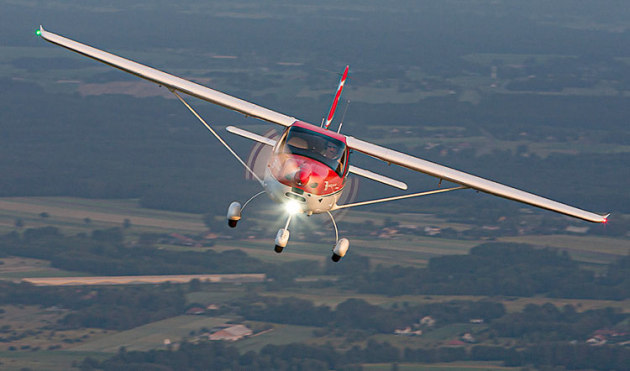
Italian GA manufacturer Tecnam last week outlined its plans to manufacture aircraft to the new light sport aircraft (LSA) standard.
Known as Modernisation of Special Airworthiness Category (MOSAIC), the new standard, once fully adopted will enable larger and more complex aeroplanes to be introduced without the need for type certification.
Critically, the new standard will enable LSAs to have maximum take-off weights well in excess of the current 600 kg limit and a stall speed up to 59 knots, which has prompted Tecnam to review their product offering.
"[MOSAIC] represents one of the most significant regulatory shifts for general aviation in North America in years," said Tecnam Managing Director Giovanni Pascale Langer in a video briefing.
"From that moment, we took our time. We analysed the framework, reflected on its implications and studied how to properly apply it.
"Even though consensus standards are still being finalised, Tecnam already has a very clear and structured strategy for this new phase of aviation."
Langer said that Tecnam would introduce a new aircraft family called Modernised, Optimised Sport Aviation Initiative K59 (MOSAIK59), with current airframes reassessed and in some cases modified to take advantage of the new rules.
"We have no intention of building experimental aircraft to fit into MOSAIC," he stressed. "Our goal is, as always, to deliver the safest, best-in-class, fully-compliant aircraft to the aviation community with no compromises."
MOSAIK59 will include the P2008, Astore GT, P2010 and P2006T, with the P92 Echo MkII remaining unchanged.
The P2008 will soon be available with a choice of the 100-hp Rotax 912iS engine, or the larger 160-hp 916iS. Both variants will have an MTOW of 721 kg under the new standard.
Tecnam's low-wing, the Astore will be relaunched as the Astore GT with the 916 engine, air conditioning, an airframe parachute and 721 kg MTOW. According to Langer, this will reposition the Astore at the top end of the category and allow the airframe to reach a higher potential.
Fitting the P2010 and P2006T twin into the LSA category has not proven as straight-forward due to the 59-kt stall speed requirement, resulting in modifications to both airframes. However, Tecnam believes doing this will provide LSA pilots with the opportunity to fly a much wider range of aircraft than has been available to them.
"Until today, sport pilots to remain fully compliant with the regulations were limited to a very narrow selection of aircraft," Langer points out. "With MOSAIC, these limitations were finally removed.
"Pilots now have access to a much wider range of aircraft, but only if OEMs are willing to invest the time, the engineering effort and the responsibility to develop them with the high standards, like Tecnam is doing."
Although the MOSAIC regulations are now in force in the USA, CASA has yet to adopt the new rules for Australia.
However, in a briefing supplied last November, CASA indicated it was working on its policy approach with the aim of phasing in MOSAIC here.
Tecnam Australia's Bruce Stark sees the advantages of the MOSAIK59 family for Australian pilots.
"While the effect of a twin being eligible for Sport Pilot Licence holders, I believe that we are ahead of the USA in that a CASA pilot with a Class 5 medical can fly the Tecnam and other twins with one passenger," he told Australian Flying.
"I believe that the item for CASA to clear up is where RAAus administration stops in terms of aircraft, pilot endorsements and owner maintenance of older GA aircraft."
Stark lists better take-off performances, higher useful loads, more fuel and better touring aircraft as advantages of the new category that particularly suit Australian conditions.
Sling, Jabiru, Brumby and Bristell already have models that fit into the MOSAIC framework.
- Steve Hitchen