


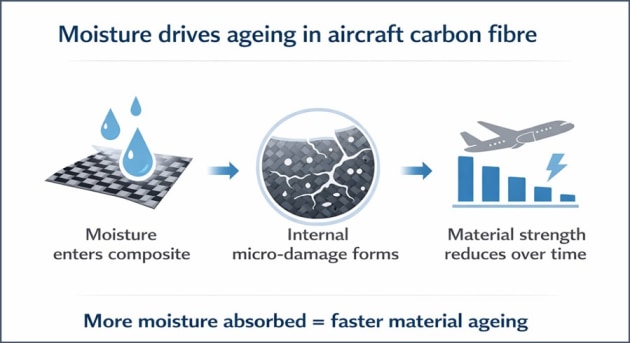
New research from Monash University and RMIT has found that moisture absorption, rather than temperature alone, is the primary driver of how carbon fibre used in aircraft degrades over time.
The findings could help the aerospace industry better predict material ageing, refine maintenance schedules and design longer-lasting composite structures.
Carbon fibre reinforced polymers are widely used in modern aircraft due to their strength, light weight and resistance to corrosion. However, the materials can gradually absorb moisture during service, weakening internally over time.
The study examined how different carbon fibre laminate designs aged under a range of hot and humid conditions, aiming to determine whether temperature caused different types of damage or simply accelerated ageing.
Researchers found the amount of moisture absorbed by the material was the dominant factor in degradation, regardless of the specific temperature or humidity conditions.
Dr Katherine Grigoriou, from Monash University’s Department of Mechanical and Aerospace Engineering, said the results help resolve a long-standing question in aerospace materials testing.
“What we found is that it’s not the exact ageing temperature or humidity that matters most, it’s how much moisture the material ultimately absorbs,” she said.
“This means that if we understand how moisture builds up inside a composite structure, we can much more reliably predict how it will perform over many years in service.”
The findings also support the continued use of accelerated ageing tests, commonly used by engineers to simulate decades of environmental exposure in a shorter timeframe.
“Our results show that accelerated ageing methods can still provide reliable predictions of long-term performance, as long as the moisture content in the material is properly understood and controlled,” Dr Grigoriou said.
The research also highlighted the importance of internal fibre arrangement, with some laminate designs proving more resistant to moisture-related degradation than others.
Using advanced imaging techniques, researchers observed microscopic damage developing over time, including voids, cracking and weakening of the bond between fibres and the surrounding polymer.
The study’s authors say the findings could improve composite design, inform maintenance strategies and increase confidence in the long-term safety of aircraft structures.
Read the research paper here.