


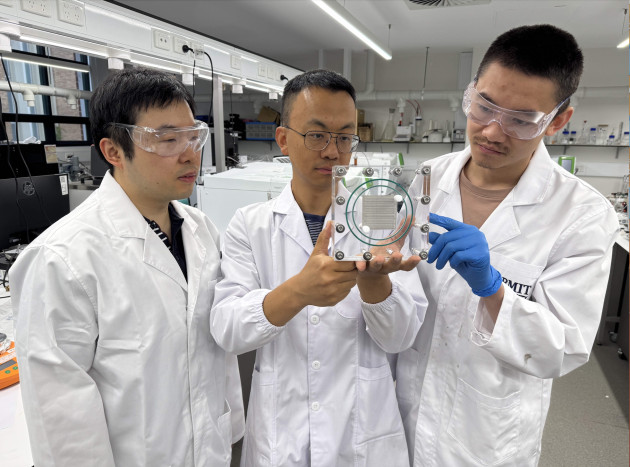
Researchers at RMIT University have developed a new carbon-conversion technology that could one day help turn industrial emissions into jet fuel, offering a potential boost to aviation’s transition to lower-emissions operations.
The system combines carbon removal and conversion into a single process, simplifying how carbon dioxide is recycled and reducing the energy use and complexity that limit many existing approaches.
Distinguished Professor Tianyi Ma, from RMIT’s School of Science, said traditional carbon-conversion methods had treated capture and processing as separate steps, driving up costs and energy demand.
“Current approaches have often been inefficient and energy-intensive,” Ma said.
“By bringing the steps of conversion together, we have been able to simplify the process and reduce unnecessary energy losses.”
The technology converts carbon dioxide from industrial exhaust gases into basic chemical building blocks that can be upgraded into low-emissions jet fuel and other products, using established industrial processes. While the system does not directly produce aviation fuel, it generates key ingredients that can replace fossil-based inputs.
Supporting aviation’s decarbonisation challenge
Aviation remains one of the most difficult sectors to decarbonise, particularly for long-haul and high-utilisation operations. Battery-powered aircraft are unlikely to support large-scale long-distance flying, while demand for sustainable aviation fuel continues to exceed global supply.
Rather than replacing existing fuel technologies, the RMIT system is positioned as a complementary option, particularly near major industrial emission sources.
Lead author Dr Peng Li said the research focused on improving efficiency in real-world settings.
“Our approach has reduced the number of processing steps and lowered energy demand compared with conventional systems,” Li said.
“The RMIT system operates without the need for highly purified carbon dioxide, which is important in real industrial environments.”
The research has been published in the international journal Nature Energy. Independent expert Dr Federico Dattila, from the Polytechnic University of Turin, said the advances brought industry closer to fully integrated, low-energy carbon-conversion systems.
Moving from lab to industry
To support practical deployment, the RMIT team has already developed a three-kilowatt prototype system and is now planning a 20-kilowatt pilot plant to test performance under industrial conditions.
The researchers are working with industry partners including Viva Energy, Hart Bioenergy, T-Power, Aqualux Energy, CO2CRC, ViPlus Dairy and CarbonNet to guide pilot-scale development and future commercial pathways.
Ma said industry collaboration was essential to the project’s success.
“Scaling up has to happen hand in hand with industry,” he said.
“That is the only way to understand what would work in practice and what still needs improvement.”
The team aims to develop a 100-kilowatt demonstration system within five years and reach commercial readiness in around six years.
Hart Bioenergy chief executive Doug Hartmann said the technology offered both environmental and operational advantages.
“This innovation has shown how emissions reduction could go alongside cost efficiency and better energy use,” he said.
“It points to production processes that can benefit the environment without ignoring economic realities.”
A complementary pathway
With growing industry interest, the researchers are now progressing plans for a spin-off company to explore commercial deployment.
Future work will focus on scaling performance and assessing how the system could contribute to producing aviation fuel, industrial chemicals and other carbon-based materials.
Ma said the technology should be seen as part of a broader transition.
“This is not a silver bullet,” he said.
“It is about developing practical tools that could help industries and governments reduce emissions while making use of existing systems during the transition to cleaner fuels.”