


This discussion is to promote safety and not to establish liability. CAA’s report contains padding and repetition, so in the interest of clarity, Jim Davis has paraphrased extensively.
Jim’s comments
What a pleasure it is to read a well-written accident report. A few things jump out at me as I read this. I find the first very worrying.
Rebuilt aircraft
Some years ago I did a test flight on a C150 that had suffered damage to the right wing. The wing had been rebuilt by Ian Ritchie in Port Elizabeth.
The aircraft flew fine when straight and level but when I stalled her in various configurations, she flung the right wing down violently. Ian was much amazed by this. He pulled out his measuring equipment and we both went through the figures for angle of incidence, washout and dihedral very carefully.
He made a couple of small adjustments and I tested it again with identical results. He then got the chief Cessna engineer to fly down from Comair headquarters in Johannesburg.
There was more measuring, adjusting and consulting with the factory in the USA. Nothing changed. Eventually everyone threw their hands in the air and gave up. A new wing was flown out from America and she flew perfectly. The rebuilt wing was retired in a mixture of puzzlement and disgrace to lean against the back wall of the hangar where it made a splendid home for generations of rats.
I have heard similar stories of apparently serviceable Cessna wings causing grief. It seems that despite appearances they are not all equal. You have possibly flown one-series Cessnas that prefer to drop a particular wing on the stall. Or ones that don’t want to spin in a certain direction.
It seems the rigging of those wings can be critical compared to Cherokees which are totally predictable on the stall.
Which brings us back to this accident. The fairly inexperienced commercial pilot was simply told to fly the aircraft and test it for “…straight and level flight.”
That’s really not good enough. A far more experienced pilot should have taken that aircraft up to 3000’ and tested its behaviour at the stall in all configurations.
Unfortunately we will never know whether the accident was caused by a potentially twitchy aircraft.
Having said it was a good report, they then give the wind in km/hr relative to true north. So I had to untangle that to work out that she had an 8kt, 70° crosswind from the right. Is this why the crash site was 215’ left of centreline, or had she fallen into the trap of not using enough right rudder during takeoff and climb?
Now we come to more serious stuff. She had a density altitude of 5347’ but the mixture was fully rich leaving her well short of power. It seems this was the first time she had ever experienced summer temperatures for this operation.
Finally, and worst of all, she seems to have been flying at and indicated airspeed of 46 kts (if the report has untangled it’s GS and CAS IAS figures correctly). That means she was on the edge of a stall, and close to 20 kts too slow.
The POH calls for an IAS of 65 knots, and says she should have had a rate of climb of 475 ft/min.
I believe that if she had leaned out correctly and climbed at 65 knots there would not have been an accident. So was the crash due to poor training, poor flying or poor rigging on the aircraft?
Sadly we will never know. But we can still learn from this unfortunate girl’s death. 
A far more experienced pilot should have taken that aircraft up to 3000’ and tested its behaviour at the stall in all configurations.
Background Information
The accident aircraft had been damaged on a previous forced landing in July 2023. The wings were removed before it was transported via road to the maintenance facility. The left wing was reinstalled and a repaired replacement right wing was fitted.
History of the flight
On 28 August 2023, at Claresholm Industrial Aerodrome (60 nm S of Calgary) Canada, [after the rebuild] the aircraft was conditionally released by the AMO pending a satisfactory test flight for straight and level flight. The pilot would then provide the final signature to release the aircraft back into service.
At about 1600, during her preflight inspection, the pilot noticed a leak on the right fuel tank. The tanks were then filled to maximum capacity to troubleshoot the leak. After the leak was rectified, the aircraft was again conditionally released for the test flight.
The pilot occupied the right seat, which was the seat that she normally used when conducting aerial photography. After the run-up, the pilot taxied into position on runway 03 and commenced the takeoff at 1928.
The aircraft was observed getting airborne in the first third of the runway (about a 1000-foot take-off roll) and commencing a shallow climb on the runway track. At about 1 nautical mile from the aerodrome, several eyewitnesses described the aircraft in a shallow climb and then turning sharply to the left before entering a steep turning descent.
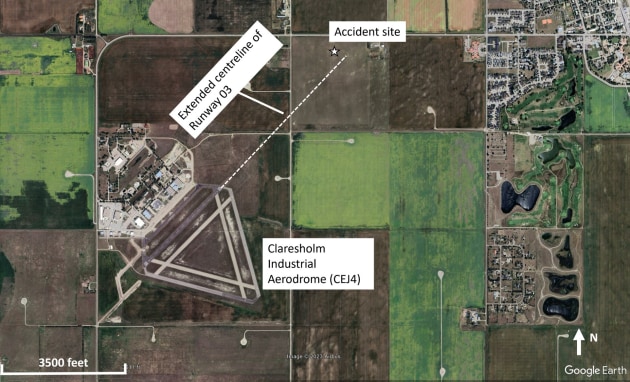
The aircraft impacted the ground 5200 feet from the departure end of runway 03 and 215 feet left of the extended centreline. The pilot received fatal injuries. The aircraft was substantially damaged. There was no post-impact fire.
Aircraft Information
Ground scars were consistent with the aircraft contacting the ground in a spin to the left. The flaps were in the up position, the elevator trim was in the take-off position, the throttle control was set to full power, and the mixture control was set to full rich. Damage to the propeller was consistent with power being produced at impact.
The aircraft had long-range tanks with a total capacity of 37.5 US gallons.
The aircraft was equipped with a digital engine monitor which recorded an increase in fuel flow at 1928:20. That stabilized at about 8 U.S. gallons per hour, which is consistent with take-off power. The recording ceased 93 seconds later.
During that time the fuel flow and engine temperatures were consistent with the engine producing power and were similar to previous flights recorded by the monitor.
All aircraft components were located in close proximity, including both wings and vertical and horizontal stabiliizers. The continuity of the flight control system was verified. The pitot system, stall warning system, and engine were examined. No anomalies were found.
The seat position was appropriate for the pilot to be able to reach the flight controls.
The aircraft C of G was within the envelope and it weighed 1543 pounds at takeoff. This is 127 pounds below its maximum gross weight.
The investigation did not discover anything that could have led to the stall and spin.
Weather Information
30 minutes before the accident, a nearby station reported:
Temperature 29.5 °C
Dew point 3.8 °C
Wind 120° (T) at 15 km/h
Aircraft performance
The density altitude was 5347 feet ASL at the time of the accident. The POH advises that to achieve maximum engine rpm, the mixture control should be leaned anytime that operations are conducted above 3000 feet ASL.
The combination of high temperature and high elevation can drastically reduce the performance of the airplane in the following ways:
the engine power is decreased because its fuel/air mixture is reduced
the propeller develops less thrust in thin air
the wings develop less lift in thin air.
As a result, the take-off performance is substantially reduced.
According to the POH, with the aircraft at its maximum take-off weight, flaps up, mixture leaned for maximum engine rpm, and for the density altitude at the time of the occurrence, a maximum rate of climb of 475 fpm can be achieved at 65 knots IAS.
Based on available information the average ground speed from the application of take-off power to the spin entry was 53 knots. Applying the wind and prevailing conditions gives a 50-knot average CAS (46 knot IAS). The stall speed when the aircraft is at its maximum take-off weight, with flaps up, and wings level is 48-knots CAS.
Spins
Entry into a spin can occur at practically any airspeed, as long as there is sufficient yaw while the aircraft is stalled. For spin recovery the POH calls for:
Ailerons: neutral
Throttle: idle
Rudder: full opposite to rotation
Elevator: forward until rotation stops
Rudder: neutral
Elevator: ease out of the dive.
Note: allow at least 1000’ for a 1-turn spin and recovery.
Pilot Experience
This was the pilot’s first summer with the company. When she was hired in June 2023, she held a valid Category 1 medical certificate, a commercial pilot licence – aeroplane, a multiengine rating, and a Group 1 instrument rating, and she had accumulated 256 hours of flight time.
She then acquired 135 hours with the company. At the time of the occurrence, her total flight time was 391 hours, mainly on the Cessna 150/152 aircraft. Her commercial pilot licence was valid.
The pilot had not flown in the 31 days before the accident because the aircraft was being repaired.
What can we learn?
• Don’t be a test pilot if it’s not your job.
Correct leaning is a live-longer skill.
Density altitude is a killer.
Always use POH speeds.
Jim Davis is a natural teacher with a passion for flying training, believes in learning through enjoyment. His book is refreshingly un-textbookish yet thoroughly covers its subject clearly. With over 15,000 hours, including 10,000 in flying instruction for civilian and military pilots, Jim founded South Africa’s largest and most respected flying school, 43 Air School. He is also an author of multiple books on flying training and has contributed numerous articles to flying magazines across two continents. https://www.jimdavis.com.au